Opening with the steam distillation method, the leading traditional technique for extracting pure essential oils from natural raw materials. Are you looking to learn how to safely obtain essential oils while preserving their full natural value? Let’s explore the principles and key features to apply them effectively today.
Working Principles
The Steam Distillation method is based on the diffusion, osmosis, dissolution, and steam entrainment of organic compounds found in the essential oils contained within plant tissues, when exposed to high-temperature steam. Diffusion occurs more easily when the essential oil-containing cells swell as the raw material comes into contact with saturated steam over a certain period of time.
In cases where plant tissue contains waxes, resins, and long-chain fatty acids, more steam must be used and the distillation must be carried out over a longer period of time, as these compounds reduce the overall vapor pressure of the system and make diffusion more difficult.
Distillation can be defined as: “the separation of the components of a mixture of multiple liquid compounds based on the differences in their vapor pressures.”
In the simple case, when distilling a mixture of two mutually immiscible liquid compounds, the total vapor pressure is the sum of the two partial vapor pressures. Therefore, the boiling point of the mixture will correspond to a specific total vapor pressure, regardless of the percentage composition of the mixture, as long as both liquid phases still exist at that point.
If we plot the vapor pressure curve of each compound as a function of temperature and then draw the total vapor pressure curve, for each pressure we can easily derive the corresponding boiling point of the mixture and observe that the boiling point of the mixture is always lower than the boiling point of each individual compound.
It is precisely because of these boiling point-lowering properties that the steam distillation method has long been the first method used to separate essential oils from plant raw materials.
Characteristics of the Steam Distillation Method
The steam distillation method stands out for its ability to preserve natural active compounds, making it suitable for natural raw materials rich in essential oils such as eucalyptus or tea tree. This characteristic gives the essential oils an authentic fragrance and higher therapeutic efficacy compared to solvent extraction. In practice, this method accounts for 70% of global essential oil production due to its low cost and ease of scaling.
Diffusion
An important characteristic of the steam distillation method is the rapid diffusion of steam through the layer of raw material. Steam creates a pressure gradient, driving the essential oil to move from high-concentration areas inside the cells to lower-concentration areas outside, following Fick’s law. This process takes only 30–60 minutes depending on the plant type, helping to increase efficiency by up to 2–5% compared to soaking.
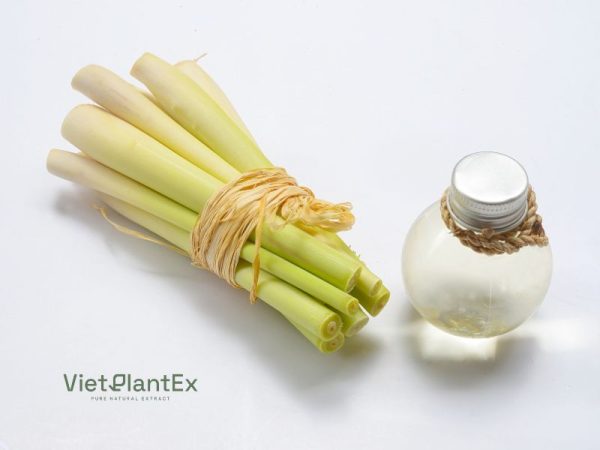
I often advise beginners to carefully control the steam flow rate at 1–2 liters/minute to ensure even diffusion and avoid rupturing cells too aggressively, which can introduce impurities. This diffusion process is precisely the reason why Vietnamese lemongrass essential oil consistently has a high citral content, meeting European export standards.
Hydrolysis
The steam distillation method also features a mild hydrolysis characteristic, in which steam reacts with certain glycoside compounds in the raw material to release free essential oils. This process occurs under the naturally mild acidic conditions of plants, increasing yield by 10–20% without altering the primary structure. For example, with jasmine flowers, hydrolysis facilitates the easier release of linalool.
However, it is necessary to monitor the distillation time and keep it under 2 hours to avoid excessive hydrolysis that can lead to a sour odor. From practical experience, I find this characteristic ideal for moist raw materials such as orange peel, yielding a high-quality essential oil rich in limonene.
Temperature
Another outstanding characteristic of the steam distillation method is the precise temperature control at 100–120°C, which is lower than the boiling point of most essential oils (150–200°C). This temperature prevents thermal decomposition, preserving monoterpenes and sesquiterpenes — the main therapeutic active compounds. Modern equipment uses automatic sensors to maintain stability at ±1°C.
In production in Vietnam, I recommend using a double boiler still to keep the temperature from exceeding 105°C for sensitive essential oils such as lavender. This low-temperature characteristic makes the steam distillation method the top choice, ensuring that the essential oil retains 95% of its original potency.
The steam distillation method is truly a reliable technique for anyone passionate about natural essential oils. When applied correctly, you will have a high-quality product suitable for both commercial sales and household use.
Essential Oil Distillation Methods
Among the most popular steam distillation methods today, there are three prominent approaches widely used to extract essential oils from natural raw materials. These methods are not only straightforward but also highly effective, helping to preserve the valuable compounds in essential oils. Below, we will explore each steam distillation method in detail — from basic to advanced — so you can easily choose the one best suited to your production needs, whether at home or on a larger scale.
Water Distillation
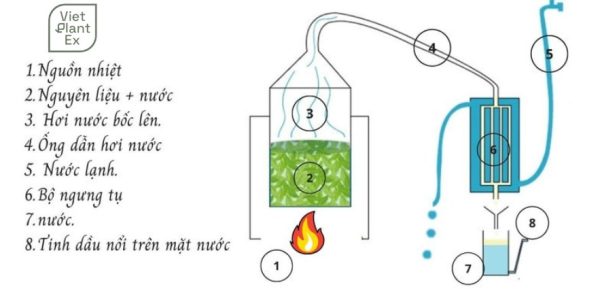
Water distillation is the most traditional method among all steam distillation methods, commonly used for leaves, soft flowers, or water-absorbent raw materials such as lavender and Roman chamomile. The raw material is completely submerged in water, which is then brought to a boil to generate saturated steam inside the still. The steam carries the essential oils upward, passing through a cooling system and condensing into a mixture of water and essential oil.
This process is simple and suitable for beginners practicing steam distillation at home. All you need is a sealed distillation flask, a steam pipe, and a condenser. Distillation time typically ranges from 2–4 hours depending on the raw material, maximizing the extraction of water-soluble active compounds. The main advantage is low cost and no need for complex equipment, but the downside is that direct high heat can decompose some sensitive compounds in the essential oil.
With 10 years of experience working with natural raw materials, I advise maintaining even heat to avoid scorching the raw material and to ensure the essential oil meets quality standards.
Water and Steam Distillation
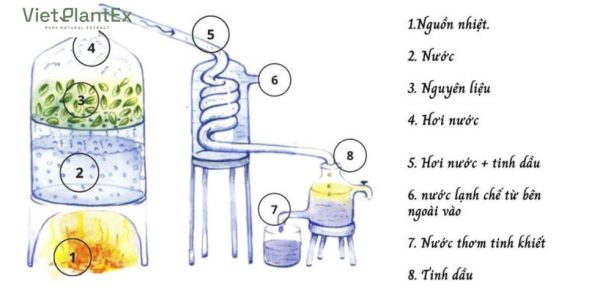
Building on the simplicity of water distillation, the water and steam distillation method combines the advantages of both, making it ideal for roots, hard bark, or raw materials containing hard-to-volatilize essential oils such as ginger and turmeric. The raw material is placed in a separate compartment, partially submerged in water, while hot steam from an external source is introduced to agitate and carry along the essential oils. The steam mixture is then condensed separately, making it easier to separate the essential oil layer.
This method stands out among steam distillation methods for its superior temperature control, reducing the risk of compound degradation. Distillation time is approximately 3–5 hours, with an ideal water-to-material ratio of 1:3 to optimize efficiency. I often apply this method for mixed raw material batches at the workshop, as it is flexible and produces clean essential oil with fewer water impurities. If you are experimenting with small-scale steam distillation, use a bamboo basket to hold the raw material to prevent steam blockage, ensuring the process runs smoothly and safely.
Steam Distillation
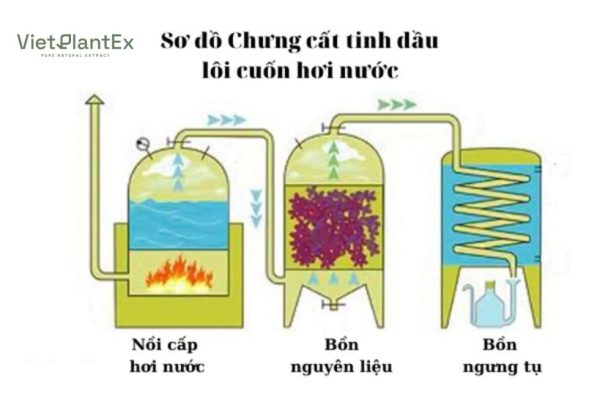
The most modern method favored in the essential oil industry for its superior efficiency with wood, seeds, or plant trunks such as sandalwood and cinnamon. Dry raw material is placed on a support rack inside the distillation chamber, and hot steam from a separate source (a steam boiler) is pumped through without direct absorption, carrying the essential oils to volatilize at a lower temperature (approximately 100–150°C). The steam is then condensed and separated into pure essential oil.
Compared to the two methods above, this approach within the steam distillation method best preserves the original fragrance, with a distillation time of only 1–3 hours depending on the thickness of the raw material. The equipment requires stable steam pressure and a dedicated condensation system, but the results are well worth the investment. With over 10 years of experience, I consider this the top choice for premium essential oils, as it minimizes oxidation and preserves anti-inflammatory and antibacterial active compounds. You can start with a mini distillation unit to experience a clear difference compared to manual methods.
Advantages and Disadvantages of the Steam Distillation Method
The steam distillation method is a well-established technique in the essential oil extraction industry, particularly popular with natural raw materials such as lemongrass and lavender.
This technique is not only simple but also highly effective, helping to preserve the aroma and valuable active compounds from herbs.
Outstanding Advantages
The steam entrainment distillation method offers many practical benefits, making it the top choice for both industrial production and laboratory steam distillation. Below are the key advantages:
- Preserves essential oil quality: Low temperatures (around 100°C) help protect heat-sensitive compounds without denaturing the active ingredients.
- High efficiency: Suitable for fresh raw materials such as leaves, flowers, and plant stems, extracting 0.5–2% essential oil in just 2–4 hours.
- Reasonable cost: Simple equipment, easy to set up, and energy-efficient compared to methods using chemical solvents.
- Hygienic and safe: Leaves no toxic residues, ideal for organic essential oils used in cosmetics and food products.
In practice, I once applied this method to lemongrass essential oil at a small workshop, achieving a recovery rate of over 90%, allowing the product to compete effectively in the market.
Disadvantages to Note
Despite its effectiveness, the steam distillation method still has certain limitations that you should consider before applying it. These issues can be especially relevant in laboratory-scale steam distillation.
Below is a summary table of the advantages and disadvantages of the steam distillation method for easy comparison:
| Advantages | Disadvantages |
| Preserves natural active compounds | Only suitable for volatile raw materials |
| High efficiency, short processing time | Consumes large amounts of water and fuel |
| Safe, no chemicals | Cannot extract heavy essential oils |
| Easy to apply from lab to industrial scale | Requires strict temperature control |
Specifically, this method is less effective for roots or resins with high boiling points, and the large volume of wastewater generated can be an environmental concern if not properly managed. Additionally, if the raw material is not fresh, the proportion of impurities in the essential oil will increase.
In summary, the steam distillation method remains a reliable “companion” for anyone passionate about natural essential oils. Based on my experience, prioritize using fresh raw materials and quality equipment to overcome its disadvantages.
If you are experimenting with steam distillation of lemongrass essential oil, you can do it yourself at home. However, to ensure safety and optimize both cost and essential oil quality, you should turn to professional natural raw material suppliers such as VietPlantEx.
The above is our answer to the question “what is the steam distillation method?”, and we hope it has addressed all of your questions.